KAZUO SHIRAGA - WORK
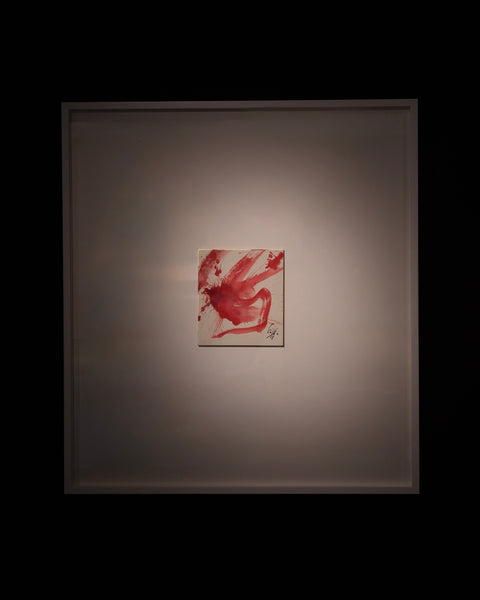
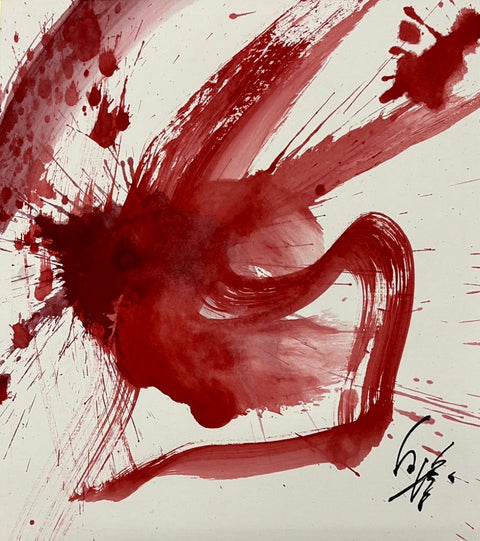
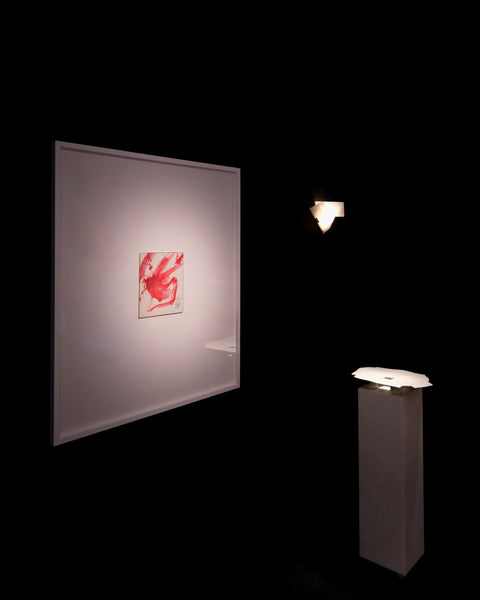
Regular price€0,00 Sale priceKAZUO SHIRAGA (1924-2008) WORK │ JAPAN, CIRCA 1974
WATERCOLOUR ON PAPERBOARD
WITH THE ARTIST SIGNATURE AND SEAL
COMMITTEE ISSUED BY JAPAN ART DEALERS ASSOCIATION
H 27.5 x L 20 cm / H 10,8 x W 7,8 in.
ABOUT KAZUO SHIRAGA
Kazuo Shiraga was not a painter in the traditional sense; he was a man who turned painting inside out. Born in 1924 in Amagasaki, near Osaka, he came of age in a Japan shattered by war and searching for renewal. From that tension he drew his purpose to make art that was not polite, not decorative, but alive. He began as a student of nihonga, traditional Japanese painting, yet quickly found its delicacy too constrained. What he wanted was friction, collision, and release. When the Gutai Art Association formed in 1954, a collective devoted to breaking art open through action and experimentation, Shiraga found his language. His body became his instrument, his movements the brush. Suspended by ropes, he hurled himself into his canvases, smearing pigment with his feet, collapsing the distance between creation and destruction. The result was painting as performance, an arena where energy and matter met head-on. Thick rivers of red, black, and ochre twist like entrails or earth after battle. The work does not illustrate violence; it enacts it. Each surface carries the trace of a body in motion, an artist both fighting and surrendering to his medium. Beneath that fury, however, was structure. Shiraga’s process was not random but ritualistic. He prepared his surfaces meticulously, considered his palette like a composer setting a key. Later in life, as a monk of the Tendai sect, he saw the act of painting as a form of spiritual discipline, a purification through exhaustion. His canvases became records of transformation: sweat, pigment, and soul bound into one material event. Where American Abstract Expressionism turned gesture into myth, Shiraga made it immediate and physical, closer to martial art than to painting. His contemporaries saw in his work a kind of resurrection: art reborn not from thought but from struggle. Today, his paintings occupy a rare position, simultaneously sacred and carnal, serene and violent. They pulse with the memory of movement, as if the body that made them had only just stepped away. In them, Shiraga collapsed the border between art and life, leaving behind not images but evidence, proof that to create is, quite literally, to live through the act.