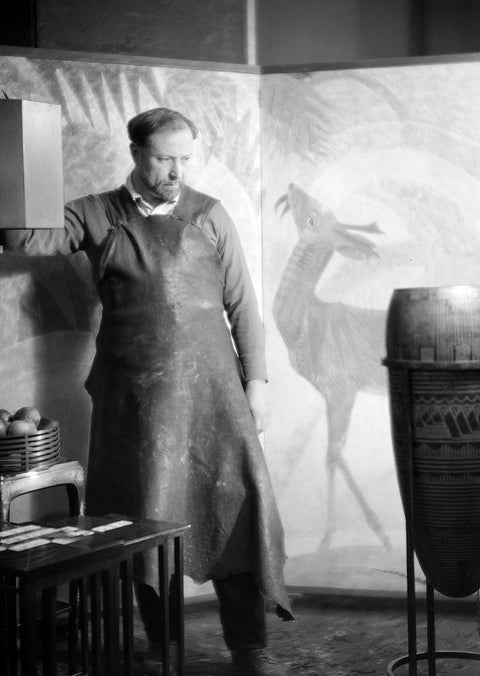
Jean Dunand was one of the great orchestrators of modern material poetry, a figure who stood at the crossroads of art, craft, and technology during the first half of the twentieth century. Trained at the École des Arts Industriels in Geneva, Dunand arrived in Paris at the end of the nineteenth century, where he entered the atelier of Jean Dampt and quickly distinguished himself as one of the most accomplished metalworkers of his generation. It was through the ancestral technique of dinanderie, the hammering and shaping of copper, brass, and bronze that Dunand first made his mark, elevating a craft of utility into a discipline of form and rhythm.
His repoussé vases and bas-reliefs of the 1900s already displayed an understanding of metal as a living surface, capable of vibration and resonance. But it was the encounter with the Japanese lacquer master Seizo Sugawara around 1912 that catalyzed a deeper metamorphosis. Through Sugawara, Dunand learned the secrets of urushi lacquer, absorbing an Eastern patience and ritual into a Western pursuit of structure and abstraction. Over the following decades, he fused dinanderie and lacquer, hammered form and liquid surface into a visual language that embodied the spirit of French Art Deco: Refined, modern, and rigorously balanced.
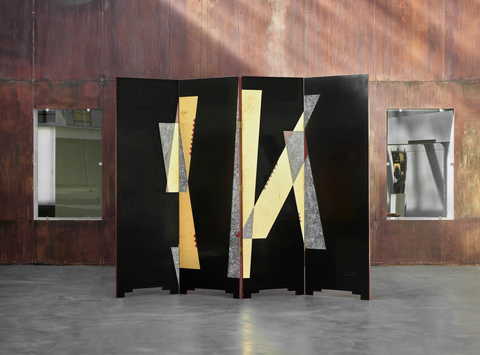
Dunand’s lacquers and panels, often combined with eggshell, gold, and silver powders, became symbols of the age’s fascination with precision and opulence. Collaborating with Pierre Patout, Jacques-Émile Ruhlmann, and Eugène Printz, he contributed to interiors that defined modern French taste, from the Normandie ocean liner to the salons of the 1925 Exposition Internationale des Arts Décoratifs. His work was monumental yet introspective, its silence forged through the repetition of labor layers.
What sets Dunand apart is his synthesis of intellect and material intuition. He understood the surface as a site of philosophical inquiry, an interface between permanence and transformation. Each curve, each reflection in his metal or lacquer, is a meditation on how modernity could still contain mystery. His dinanderies and lacquers do not simply decorate; they think. They embody the paradox of the machine age touched by the human hand, where precision becomes emotion, and craftsmanship becomes a form of thought.