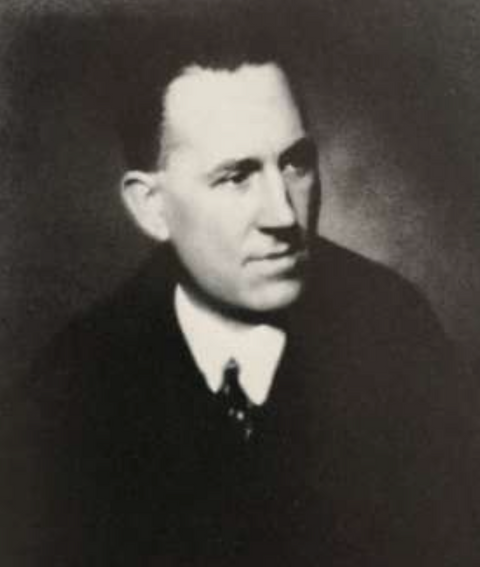
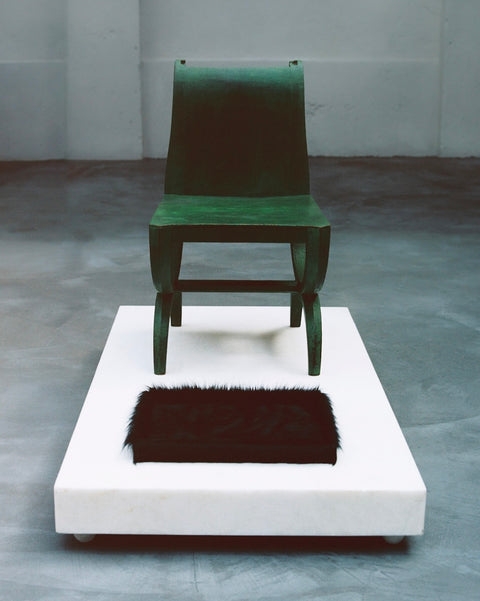
Pierre Legrain occupied a singular position within the decorative arts of the early 20th century, neither bound by tradition nor fully aligned with the emerging orthodoxy of modernism. His work unfolds as a series of bold gestures, where material, line, and surface are pushed toward tension, contrast, and unexpected harmony.
Born in Paris in 1889, Legrain did not follow a conventional path into design. Initially trained as a bookbinder, he developed an acute sensitivity to materials—leather, parchment, and exotic skins—which would later inform his radical approach to furniture. His encounter with the couturier and collector Jacques Doucet proved decisive. Through this collaboration, Legrain was given the rare freedom to experiment, producing objects that broke entirely from the decorative norms of the time. Legrain embraced asymmetry, fragmentation, and contrast. His compositions often juxtapose luxurious materials, ebony, shagreen, ivory, vellum—with stark geometric forms, creating a language that feels at once primitive and strikingly modern. A cabinet becomes an architectural statement; a surface becomes a field of collision between textures and tones.
By the mid-1920s, his work stood in sharp contrast to the refined elegance of figures like Émile-Jacques Ruhlmann. Where Ruhlmann pursued perfection through harmony and finish, Legrain introduced rupture—an energy that destabilized the object and redefined its presence in space. His furniture resists comfort in favor of intensity, inviting a more intellectual and sensory engagement. Legrain’s approach extended beyond furniture into bookbinding, where he reimagined the book as an object of sculptural and tactile expression. Here again, his sensitivity to material was paramount, transforming surfaces into compositions that could be read both visually and physically.
His career was brief, cut short by his death in 1929, yet his influence resonates far beyond its duration. Legrain anticipated many of the ideas that would later define modern and contemporary design—the dissolution of decorative conventions, the elevation of material as concept, and the acceptance of tension as a form of beauty.
Today, his works are held in major collections and institutions, not as decorative artifacts, but as early declarations of a new way of thinking. Pierre Legrain did not seek to refine the existing language of design; he fractured it, revealing new possibilities in the space between order and disruption.