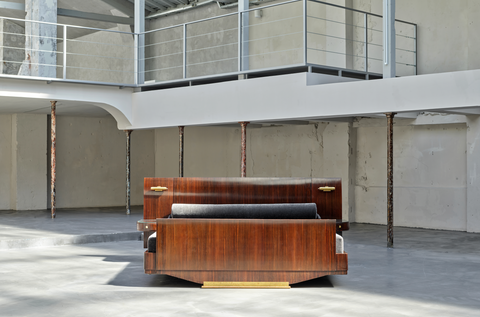
JACQUES-ÉMILE RUHLMANN - BED NO. 894 NR
Regular price€0,00 Sale priceABOUT JACQUES-ÉMILE RUHLMANN
Ruhlmann did not design furniture in the conventional sense; he constructed a vision of living where each object carried intention, precision, and quiet authority. His work belongs to a world where nothing is accidental, where proportion, material, and line resolve into a controlled harmony. Born in 1879, he inherited his father’s decorating business but quickly redefined it. Moving beyond ornament, he approached interiors as complete compositions, shaping space with near-architectural rigor. His language was neither nostalgic nor radically avant-garde, but measured, a balance between classical order and modern clarity. By the 1920s, his position was firmly established, culminating at the Exposition Internationale des Arts Décoratifs et Industriels Modernes, where his Hôtel du Collectionneur stood as a manifesto. More than an installation, it staged a way of living, where furniture, textiles, and rhythm formed a seamless whole. His materials Macassar ebony, amboyna burl, ivory, shagreen, lacquer, were selected with discipline. Surfaces became fields of tension between light and depth, never excessive, always resolved. The craftsmanship was exacting, relying on artisans capable of making structure disappear into apparent ease. He resisted industrial production not out of nostalgia, but conviction. For Ruhlmann, modernity was not speed, but elevation. His interiors functioned as total works, each detail reinforcing a unified atmosphere. After his death in 1933, his work endured not as relic, but as benchmark. Held in major collections, it continues to define the upper edge of Art Deco. His legacy lies in this tension: restraint and richness, discipline and sensuality. His pieces do not ask for attention, they impose it quietly, with a certainty that leaves little room for compromise.