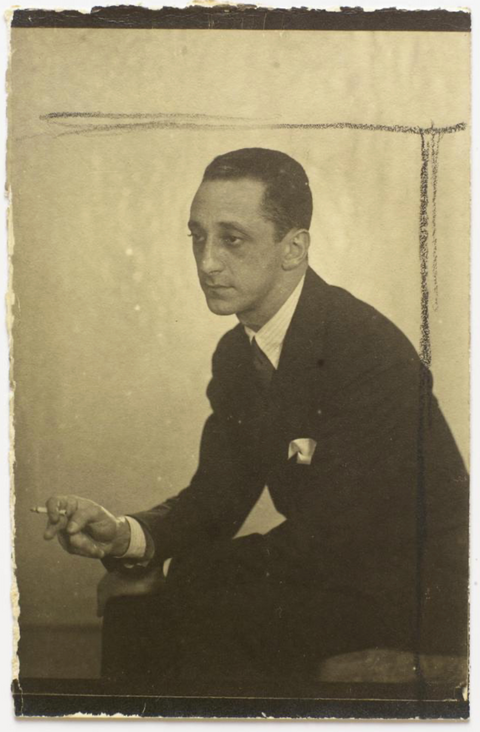
Jean-Michel Frank was not a designer of objects so much as a composer of absence, a figure who redefined modern luxury through restraint at a moment when excess still defined taste.
Born in Paris in 1895 into a cultivated bourgeois milieu, Frank emerged in the interwar years as one of the most radical voices of French interior design. Without formal academic training, he approached decoration intuitively, stripping it of ornament and narrative to reach something essential. Where his contemporaries celebrated richness through complexity, Frank pursued it through subtraction, developing a language of quiet austerity that would come to shape the very idea of modern elegance.
His interiors, created for figures such as the Vicomte and Vicomtesse de Noailles, Elsa Schiaparelli, or later Nelson Rockefeller, were defined by an almost monastic clarity. Pale palettes, raw textures, and noble materials left in a state of near-silence, parchment, shagreen, straw marquetry, plaster, or cerused oak—formed spaces where light and proportion became the true protagonists. In collaboration with Adolphe Chanaux, he translated this vision into furniture that resisted display: low, restrained, almost anonymous forms that dissolved into their surroundings.
Yet beneath this apparent simplicity lay a radical sophistication. Frank’s work was never minimal in the reductive sense; it was precise, controlled, and deeply intellectual. He understood that luxury could reside in the quality of a surface, in the tactility of a finish, in the exact relationship between volumes. His interiors offered not spectacle, but atmosphere. Spaces that invited contemplation rather than attention.
What distinguishes Jean-Michel Frank is this paradox: an aesthetic of emptiness that is, in reality, profoundly full. In a period marked by decorative exuberance and the rise of Art Deco opulence, he introduced a different form of modernity, one grounded in silence, material truth, and the refinement of proportion. His legacy endures not through signature gestures, but through a sensibility: the idea that the most radical statement can often be the quietest one.