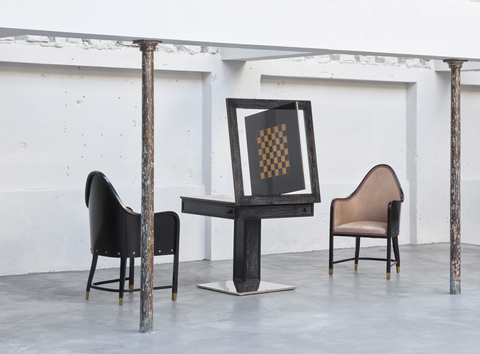
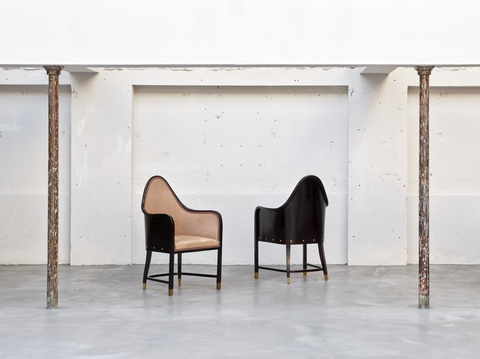
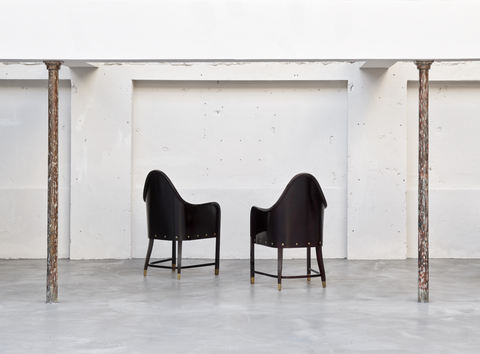
Josef Hoffmann, Pair of armchairs, model no. 330/F | Vienna, circa 1910
Tinted beechwood, brass and velvet.
Bibliography: model no. 330/F from the Kohn catalogue, listed on pages 28–29 in Il mobile moderno by G. Renzi, Silvana Editoriale, 2008
H 98.5 × W 56 × D 60 cm / H 38.78 × W 22.05 × D 23.62 in.
ABOUT JOSEF HOFFMANN
Josef Hoffmann, born in Moravia in 1870 and trained in Vienna under Otto Wagner, he emerged at a moment when architecture was expected to give order to a rapidly shifting world. Where others pursued expression, Hoffmann pursued structure. Clarity, proportion, and control were not stylistic preferences but ethical positions. Together with Gustav Klimt and Koloman Moser, Hoffmann shaped the intellectual core of the Vienna Secession. Klimt brought psychological intensity; Moser supplied graphic logic and systemic thinking; Hoffmann provided the spatial rigor that allowed ideas to become inhabitable. Hoffmann’s philosophy reaches its apex in the Palais Stoclet, where architecture, interiors, furniture, and decoration form a single, total environment. This belief found institutional form in the Wiener Werkstätte, where Hoffmann sought to erase the hierarchy between architecture and the applied arts. A chair, a textile, or a spoon carried the same conceptual responsibility as a building. Ornament was permitted only when it served structure; beauty emerged through restraint. Today, Josef Hoffmann occupies a foundational place in the history of modern design. His works are prized not only for their rarity or craftsmanship, but for what they represent: the moment when architecture became a coherent intellectual system, capable of shaping both space and life.