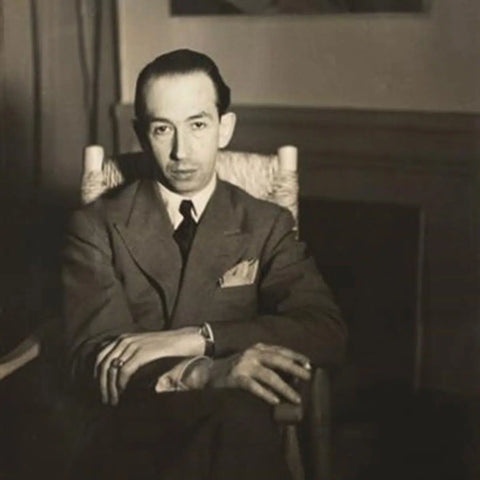
Marc du Plantier occupied a singular position within 20th-century decorative arts, standing as an enigmatic bridge between classical majesty and modern abstraction. His work unfolds as a meditation on spatial drama and proportion, stripping historicism to its essence and reinjecting it with a quiet, arresting modernity.
Born in Madagascar in 1901, du Plantier initially studied mathematics and architecture at the École des Beaux-Arts before turning to design. This background cultivated an acute sensitivity to geometry and spatial balance. Transitioning to interior architecture in the late 1920s, he approached rooms not as simple containers, but as total environments governed by light and monumental presence. He favored clean geometry and dramatic staging, harmonizing patinated bronzes, wrought iron, and rare marbles into sparse, sweeping lines.
By the late 1930s, his path diverged from both mainstream modernism and Art Deco traditionalism. Spending a decade in Madrid during World War II, du Plantier perfected a theatrical "wise modernism," fusing local ironwork and classical forms into pure symbol and scale. Where purists rejected historical reference entirely, he distilled it into atmosphere, creating spaces of frozen grandeur that favored intellectual presence over mere comfort. In the post-war decades, his practice expanded to Mexico and Los Angeles, continuously evolving toward minimalist iron, stone, and architectural sculpture while retaining his core rigor.
Until his death in 1975, du Plantier anticipated the contemporary longing for spaces that blend historical weight with minimalist clarity. Today, his works are celebrated not as relics of a single era, but as timeless declarations of pure form. Marc du Plantier did not simply follow the stylistic shifts of his century; he abstracted them, bridging the past and the future through the power of line and volume.