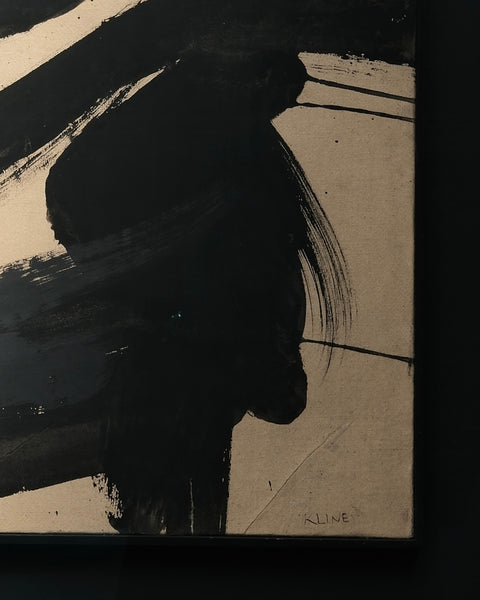
FRANZ KLINE - STRUCTURE
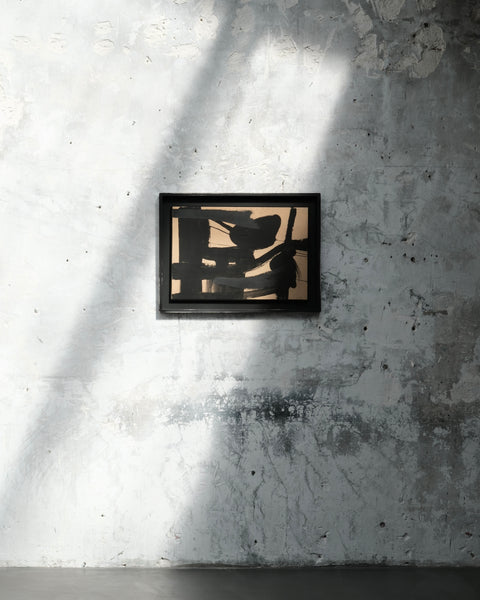
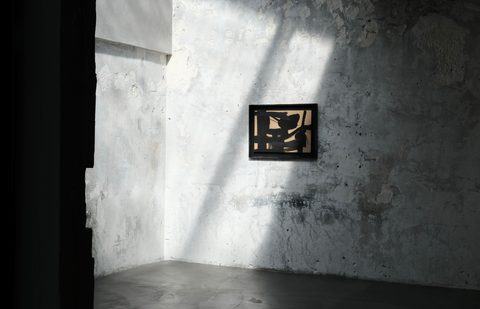
Regular price€0,00 Sale priceFranz Kline, Structure │ U.S.A, 1951
Gouache and graphite on paper, mounted on its original canvas.
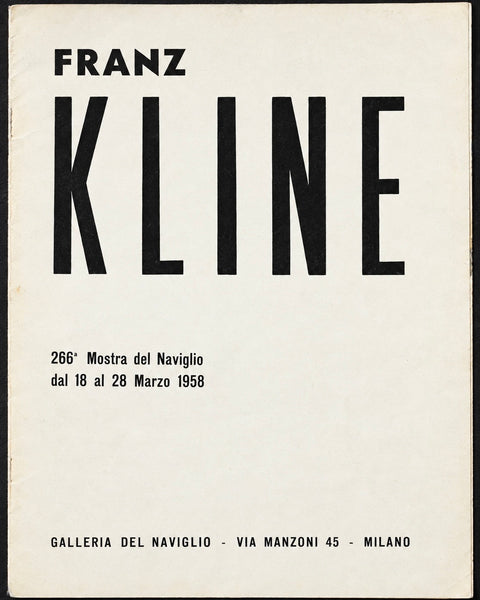
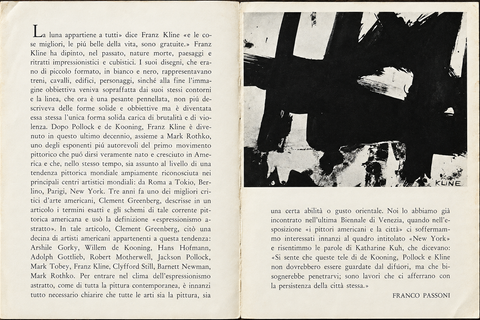
Provenance: Galleria del Naviglio, Milan, 1958, Galleria del Cavallino, Venice, Galleria il Capricorno, Venice, Private collection, Lugano (acquired in 1981), Galerie Carzaniga, Basel (acquired in 2020), Private collection, Switzerland
Exhibition: Franz Kline, Galleria del Naviglio, Milan, 18–28 March 1958
H 43,7 x L 64,2 cm / H 17,2 x W 25,3 in.
Franz Kline was a defining figure of the New York School, transforming the energy of postwar American modernism into compositions of balance, friction, and physical force. His paintings were carefully constructed confrontations between black and white, giving the canvas an almost architectural presence. Born in Wilkes-Barre, Pennsylvania, Kline grew up among the bridges, coal breakers, and locomotives of an industrial city. After studying at Boston University and London’s Heatherley School of Fine Art, he returned to New York in the late 1930s. There, he developed a figurative practice and joined the downtown avant-garde alongside Willem de Kooning and Jackson Pollock. A turning point came in 1948, when Kline saw his ink drawings enlarged through a Bell-Opticon projector in de Kooning’s studio. He recognized the expressive force of line detached from representation and began using broad house-painter brushes and commercial enamel. His 1950 debut at the Charles Egan Gallery established him at the forefront of abstraction. Kline’s white forms were as active as his black strokes, pressing against them with equal weight. He tested compositions in small studies before translating them onto monumental canvases. In his later work, he introduced fields of rust, plum, and green. Kline died of heart failure in 1962, aged fifty-one. His work is held in major collections, including the Museum of Modern Art, the Whitney, and Tate.