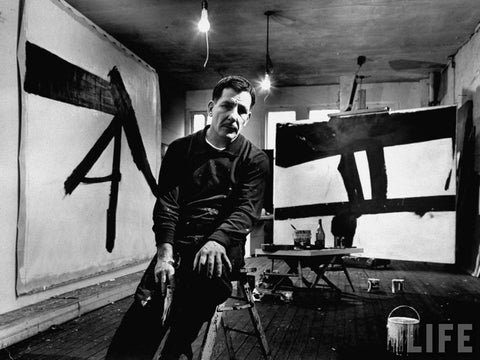
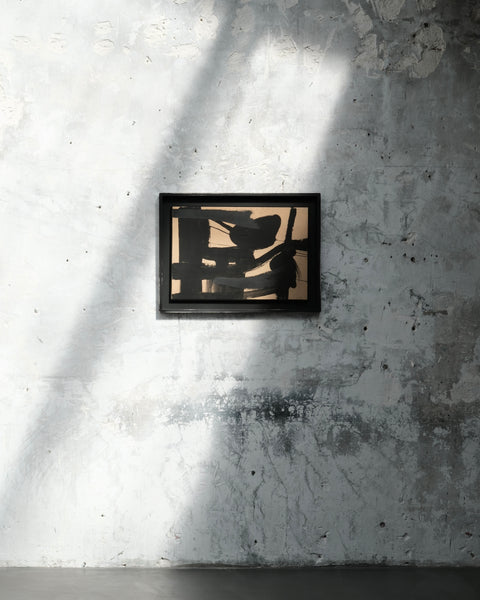
Franz Kline stands among the defining titans of the New York School, celebrated for transmuting the raw velocity of postwar American Modernism into a monumental dialectic of balance, friction, and physical authority. Far from spontaneous action painting or meditative calligraphy, Kline’s art was an exacting discipline of structural confrontation, where the canvas ceased to be a decorative plane and became an enduring infrastructure of pure painterly weight.
Born in 1910 in the anthracite mining capital of Wilkes-Barre, Pennsylvania, Kline’s aesthetic grammar was forged amid the brooding iron bridges, coal breakers, and soot-black locomotives of his industrial youth. Following early studies at Boston University and a rigorous academic grounding in classical draughtsmanship at London’s Heatherley School of Fine Art, he returned to Manhattan in the late 1930s. There, he spent a decade honing a subtle figurative mastery in Greenwich Village while becoming an indispensable, charismatic anchor of the downtown avant-garde alongside Willem de Kooning and Jackson Pollock at the historic Cedar Tavern.
The turning point occurred in 1948 in de Kooning’s studio. Viewing his own ink gestures enlarged through a Bell-Opticon projector, Kline experienced a pivotal epiphany: line stripped of representation possessed an inherent architectural force. Rather than applying traditional fine-art pigments, he armed himself with broad house-painter brushes and industrial commercial enamel.
His historic 1950 debut at the Charles Egan Gallery, followed by his representation with the legendary Sidney Janis, instantly placed him at the vanguard of modern abstraction. Kline’s genius lay in his absolute subversion of positive and negative space. While critics initially misconstrued his black marks as East Asian calligraphy, Kline was quick to correct them: his chalky, luminous whites were never passive backgrounds, but aggressive, tactile masses that pushed back against the coal-black enamel with reciprocal density and resistance. Every monumental gesture was meticulously tested through private intermediary studies on phone-book sheets and paper before being resolved on colossal canvas.
In his late period, Kline expanded this muscular vernacular, incorporating incandescent fields of rust, deep plum, and green that revealed the chromatic range of his spatial balance. Cut tragically short by heart failure in 1962 at age fifty-one,Kline’s rare and commanding output remains preserved in the world’s most prestigious institutions, including the Museum of Modern Art, the Whitney, and the Tate. Uncompromising, sovereign, and physically magnetic, his canvases stand as the ultimate physical manifestation of postwar American painterly power.